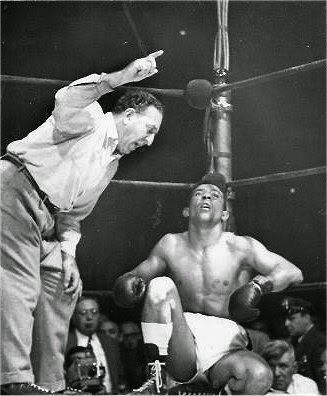
Sept 23, 1948. New York.

Jesse Flores sinks to the canvas for a fifth and final time as referee Mark Conn pushes away lightweight champion Ike Williams, Trenton, N.J., in the 10th round of a scheduled 15-round title bout at Yankee Stadium.

Bells tolled for the for the California-Mexican challenger at 2.04 of the round.

On the undercard Sugar Ray Robinson won a controversial decision in the first of two unforgettable clashes with the future welterweight champ from Cuba - Kid Gavilan.


In a six-month stretch between 1943 and 1944, Jake LaMotta and Fritzie Zivic fought four times. Three of the four bouts ended in disputed split decisions, and three of the four bouts occurred in the hometowns of each fighter. LaMotta went 3-1 against Zivic, but it wasn’t that simple.

The first Jake LaMotta vs. Fritzie Zivic bout occurred on June 10, 1943 in Zivic’s hometown of Pittsburgh, Pennsylvania. LaMotta was a major force in the middleweight division. At the time, LaMotta was a month shy of his twenty-second birthday. The Bronx Bull was already 1-2 against Sugar Ray Robinson, and was a veteran of over forty professional fights. He was young, hungry and eager for a title shot.

In stark contrast, Zivic was considered a grizzled, fading, thirty-year-old former welterweight champion. Zivic was one of the most active fighters in boxing history. Fritzie had participated in an eye-popping 170 bouts when he and LaMotta first met. Leading up to the bout, Zivic had lost four of his last seven contests.

Regardless of Zivic’s latest showings, he hadn’t lost in his hometown since dropping a decision to Charley Burley in 1939. Nevertheless, some of Zivic’s most ardent supporters were predicting doom for the quotable, carefree, and peripatetic former champion. Even Zivic’s Ph.D. in butting, thumbing and heeling wouldn’t be able to overcome natural wear and tear and LaMotta’s strength and stamina.

As it turned out, Zivic proved the skeptics wrong, but not without unexpected controversy. Weighing 151½ to LaMotta’s 155½, Zivic was too smart and experienced for the young contender. He outboxed the charging LaMotta before the hometown fans, and seemed to win an easy ten round decision. Zivic’s biographer, Timpav, describes the action and controversy surrounding LaMotta vs. Zivic 1 in his book 'Champ: Fritzie Zivic: The Life and Times of the Croat Comet'.

“At the start of the seventh, Zivic appeared to have the decision in his lap. LaMotta must have sensed it too, for he started rushing in that frame, and continued the same tactics in the 8th. Zivic, unruffled, took the 9th round with ease, and coasted to an apparent victory.

 LaMotta staged a last-round rally to win that stanza, but his face was splattered in blood flowing from gashes over both eyes.

When the decision was announced, the crowd went wild. It just didn’t make sense to the fans who just saw the Crafty Croat fight one of the most brilliant battles in his long career.

Even LaMotta was amazed when the result was announced.

Referee Al Graybar tallied six rounds for LaMotta, four for Zivic; Judge Kid Stinger had six for LaMotta, two for Zivic and two even; and Judge George Martzo scored it six for Zivic, three for LaMotta, and one even."

Fans reportedly booed the decision for a full twenty minutes. Along with several top writers, Timpav reported that Barney Ross and LaMotta’s pilot, Mike Capriano, thought Zivic won comfortably. The decision was so bad that when the rematch was ordered, new officials were appointed to oversee the action.

Zivic won the fifteen round rematch on July 12, 1943. The bout was a bloody, ebb and flow war, but it was also close and controversial. Zivic was effective in the middle rounds after taking a beating from LaMotta in the first round. LaMotta ultimately took charge and shut Zivic out in the championship rounds. The scorecards read: 8-5-2, 8-7, 5-7-3.

This time, most observers thought LaMotta won. Timpav reported that an eerie stench loomed over both decisions. In fact, part of the requirement for LaMotta vs. Zivic 3 entailed that the bout wouldn’t take place in Pittsburgh.

The rubber match occurred on November 12, 1943 at Madison Square Garden. LaMotta weighed 161 to Zivic’s 149¼. LaMotta was a 3-1 favorite.

LaMotta was the hometown fighter, but Zivic was extraordinarily popular in NYC. The 23,190 fans who witnessed Zivic’s welterweight title defense stoppage of Henry Armstrong on January 17, 1941 remains a Madison Square Garden attendance record.

As LaMotta would discover, being the hometown fighter isn’t all it’s cracked up to be. For starters, Zivic successfully bargained for five-ounce gloves with hopes of cutting LaMotta to shreds. Timpav describes the action and controversy.

“For the first five rounds it was a pip of a brawl, with Zivic apparently ahead on points. The Croat Comet cut Jake’s eye in the 4th, but LaMotta never backtracked. Fritzie got his foe to straighten up out of his familiar crouches with telling hooks and uppercuts in the early rounds.

Starting with the 6th, Jake’s punishing punches began to slow Zivic down. A cut was opened over Fritz’s eye in the 7th. The 8th, 9th and 10th rounds had LaMotta in control all the way. He showed his good form in the 9th, when he stormed over Zivic from all angles. They were still slugging it out hard at the final bell.

Jake took the decision, but it wasn’t unanimous. Referee Eddie Joseph voted for LaMotta, 6-4, as did Judge Marty Monroe. But the third official, Judge Jack Goodwin, gave 7 to Zivic and 3 to Jake.”

Much to the chagrin of LaMotta, his hometown fans reportedly rooted for Zivic during the entire bout, and loudly booed the split decision victory in his favor.

LaMotta and Zivic would fight once more on January 14, 1944. For the first time, the bout occurred at a neutral venue: Olympia Stadium in Detroit. By the same token, for the first time, the bout ended without controversy. LaMotta dominated Fritzie over ten rounds despite being penalized for low blows in the second and fourth round. The scorecards read: 8-2, 8-2, 6-3-1.

Their combined careers totaled nearly 340 bouts and over 2,600 rounds of ring activity. Despite the depth and veracity of their skill and will, neither could escape the tangled and intricate web of the hometown decision.

(by Greg Smith)


The crazy tale of the night that Paul Swiderski fought Mickey Walker...


Doc Kearns (Walkers manager) claimed he had accepted an original offer for Mickey to box Pat Dillon, a Canadian journeyman fighter, in Louisville on the eve of the Kentucky Derby in 1930, but when Dillon suffered a hand injury, the promoters asked Doc if he would accept Paul Swiderski as a substitute. Kearns would refer to Swiderski as a “local boy noted as a very rough and tough customer,” but Paul was actually a light-heavyweight from Syracuse with a so-so record. They needed spending money for the big weekend, so Kearns agreed to the fight.  

But when fight day rolled around, the promoters told Kearns that they hadn’t taken in enough money to pay Mickey’s purse. There were plenty of sporting gents in town but they had come to see the big race, not a boxing match, even if there was a world champion topping the card. Doc told them if there was no money, there was no fight. When he told Mickey, the Toy Bulldog joined in the festivities and started hitting the bars.  

It was some hours later when Kearns was called by the promoters. They had three grand for Walker if he was still sober. He wasn’t when Teddy Hayes (his trainer at the time) found him, but he was always ready for a fight, and manager and trainer set to work to get their star attraction fit for the fray. They finally got him into the ring but were hoping Swiderski wasn’t feeling too ambitious. He was.  

Kearns recalled, “Swiderski galloped across the ring at the opening bell and walloped Mickey on the chin with a right hand that knocked him flatter than a house detective’s arches. Through the next couple of minutes, Mickey was up and down like a pump handle, and finally Swiderski fetched him a smash on the jaw that knocked Mickey cold.”  

The way Kearns told it, he happened to hit the timekeeper’s gong with Mickey’s water bottle, thus ending the round. Harry Lenny (Swiderski's manager) had seen Doc’s unofficial action and jumped into the ring, yelling to the timekeeper that the round was not over. Kearns and Hayes had followed Lenny into the ring, intent on hauling Mickey back to his corner for some badly needed first aid.  

They needed a diversion and a free-for-all broke out in the middle of the ring with the local police joining in. Meanwhile Doc got Walker back to his stool, doused him with water and shoved the smelling salts under his nose. He was stirring when they cleared the ring and the bell rang for round two.  

Kearns would recall that Swiderski cornered Mickey again and knocked him out, absolutely cold. Luckily there were only five seconds left in the round and Walker was saved by the bell. But he was still virtually out on his feet when going out for round three.

For Doc Kearns, desperate times called for desperate measures, and this was one of those times. He recalled on entering the arena seeing a bank of switches in the box office, which he pointed out to Hayes. If those switches were pulled by some careless person, all the arena lights would go out. So, with the dangerous Swiderski taking aim on the hapless Walker, Doc sent Hayes off to the box office.  

Leaving the ringside, Hayes raced off to the front of the hall and found the box office. Surprising the guy in there, he yelled something about the lights, pulled on two large switches, and out went the arena lights. Then he charged back to the ring, got Walker to his corner, and worked on him. By the time the lights came on again, Mickey was shaking his head and coming out of his nightmare.  

When all the lights went out, Kearns recalled that he was in the ring and swapping punches with Swiderski, having shoved the semi-conscious Walker into a corner. He was soon joined by Hayes, who slugged Lenny, and with the crowd going crazy and the referee looking on helplessly, the cops again charged into the ring to sort things out. It took about half an hour this time to clear everybody out of the ring except the principals, and the real fight started again.  

The story of this fight is as mixed up as the circumstances leading up to it. In his “Sportlight” column, Grantland Rice wrote, “It was almost another Dempsey–Firpo melee.... It took a fighter to get back and tear in as Walker did. Only a fighting man could have staged such a counter attack. And here was $100,000 worth of drama and excitement on tap for a $7,000 house.”  

By all accounts, Paul Swiderski put Mickey Walker’s lights out in that hectic first round, and by the accounts of Kearns and Hayes, they put everybody else’s lights out. They didn’t mention a double knockdown in the opening round, yet in several reports there was such a rare happening.  

In a review for Ring magazine, Dan Daniels recorded, “The rivals connected simultaneously and both hit the canvas. Paul pulled himself up at six, Walker needed nine.... The round had gone 2:30 with the champion sprawled out on the canvas when the bell suddenly rang. Kearns had sent trainer Teddy Hayes to rap the gong in time to save Walker from being counted out.” Daniels concluded that, but for the skullduggery pulled by Hayes and Kearns, Walker would have been knocked out.

Damon Runyon, in Louisville for the Derby, was at the Walker fight. He saw the double knockdown, recording in his column a few days later, “As Mr. Swiderski speared him on the chin with a left hook, Mr. Walker’s right landing at the same instant on Mr. Swiderski’s kisser. Down they both went. ’Twas the first double knockdown these aged eyes have viewed in many a semester.”  

Somebody else remembered the double knockdown—Paul Swiderski. He would tell sportswriter/cartoonist “Lank” Leonard, “We both land at the same time and we both go down. Well, I’m the first to get up. Mickey finally makes it but he’s in terrible shape.” Swiderski also recalled the lights going out. “By the time they find a new fuse Walker is himself again and I’m tired out from giving him everything I’ve got. He finished strong and I was lucky to finish.”  

A couple of months after the fight, Swiderski talked with columnist William Braucher for his “Hooks & Slides” column. “Sure, low blows hurt,” he said, “and I still carry effects of one that Mickey handed me in Louisville. Well, just as the bell rang ending the third round, Mickey let a wild one go and it took me right in the groin. I went over on my face and felt very sick to my stomach.”  

Swiderski and manager Lenny tried to buy the pictures that were taken of the knockdowns but they were too late. Doc Kearns had already bought the plates from the only photographer who covered the fight.  Recalled sportswriter Henry J. McCormick some years later, “Swiderski’s manager had placards made up showing his boy knocking down Walker eight times. In some of the pictures the fighter purporting to be Walker wore dark trunks, in others he wore white trunks; in some pictures the fight was in a ring outdoors, in others in a ring indoors.”  

(by John Jarrett)


Feb 3, 1963.

Chris Christensen, Danish middleweight, is sprawled on the canvas, driven there by Emile Griffith's right and left to the head in the third round of their scheduled 15-round fight in Forum Stadium, Copenhagan, today. Griffith is waved away by referee Robert Seidel, of Switzerland, as he looks down on his fallen foe. Christensen was down for the count of eight in this round.
Griffith, whose world welterweight title was not at stake, won by a technical knockout in the ninth round of this fight.
(AP sports wire)

Emile Griffith celebrated his 25th birthday by successfully defending his World Junior middleweight title in Copenhagen. He stopped the 36-year old Dane, Christian Christensen in the 9th, after "Gentleman Chris" had been down twice in that round. The towel came flying in. Christensen had also been down in the 3rd.
Griffith moved in and out on the Dane, he even could take some extra seconds off to admire the effect of his combinations. The first two knockdowns were from right crosses, the final attack was a two fisted volley.
Prior to the fight, in January 1963, Boxing News reported that a member of the Danish parlament intended to stop the event, fearing that Christensen would get seriously hurt.

(boxrec)

(Griffith's World Light Middleweight Title was Recognized by the Austrian Boxing Board of Control, but by no other agencies)


“They say I haven’t trained hard enough for this fight. Who is to be the judge of how hard I work? I have worked all right, harder than most people think.” That’s Randy Turpin before the fight with Olson. He only spars 30 rounds leading up to it, and does this with his featherweight-size brother Jackie. Beats the hell out of Jackie, sure, but it ain’t a real workout. Does he not take Carl “Bobo” Olson seriously? Or is he distracted, something on his mind …

A woman. Adele Daniels. The light-skinned beauty from Harlem that Turpin met on his first trip outside of England, back in ’51 when he gave the middleweight title back to Sugar Ray Robinson, the belt he’d taken just months before.

Turpin’s in New York again and she’s hanging around. Getting crazy at his hotel, making a scene. George Middleton, Turpin’s manager, had warned Randy about Adele when they first met. Randy’s getting the message now, and he’s trying to hide out, staying at the camp, laying low. He won’t train in public, won’t talk to the press, even telling folks he may just fly back to England, forget the whole thing.

“Bobo” Olson doesn’t believe all the talk, thinks Turpin is in great shape. Thinks his opponent’s camp is trying to mess with his head, get him to let his guard down. So he trains twice as hard.

A few weeks before the match, Adele Daniels accuses Randy Turpin of assault.

The fight is held at Madison Square Garden, in front of almost 19,000. With Sugar Ray retired, the World Middleweight title is vacant – the winner will take it.

So they get to it. Turpin owns the first three rounds, despite his head being elsewhere. In the fourth, Olson opens up Randy’s cheek with a jab. They go back and forth a bit, but it’s Olson’s round. By the sixth, Olson is taking control, leading the fight.

Ninth round, Turpin gets a couple good shots in, regains confidence. He comes at “Bobo” with a left hook, but Olson slips it. Turpin comes at him with a right, but gets caught with a left hook of Olson’s. Back against the ropes, four, five, six big punches from Olson, no answer from Turpin. Randy gets off the ropes, throws his right but can’t land it. Back to the ropes and it’s left, right, left, right from Olson and Turpin goes down. He beats the count and the round is over.

Turpin’s caught on the ropes with another left hook in the tenth and is down for the second time. The eleventh, bang-bang, double-jab from “Bobo”, putting Turpin on the ropes again. Turpin gets away, only to get caught with a brutal belly shot, and he’s leaning, leaning. It goes on like this, Turpin being held up, Olson moving in, working it. Randy does get a good round off in the thirteenth, avoids punishment and dishes out some of his own, but it’s late.

In the last round, the fifteenth, Turpin lets it hang out, goes for the knockout, but he just can’t land the shot he needs. He takes the round, and there’s some pride in that, but the night is Olson’s.

“If I had been in my natural mental state, I could have stopped him about the eighth round. But I’ve had so many personal troubles recently, I wasn’t myself.” That’s Turpin after the fight. He says Olson is no Sugar Ray.

Adele Daniels drops the assault charges a couple weeks after the fight. She does end up suing Turpin for $100, 000 in damages, but gets only $3500, out of court, in the winter of ’55.

Turpin just fades after that, losing the bouts he needs to stay relevant. When he wins he’s putting down nobodies in nothing-fights. He finally retires in the early sixties. Short on cash, he turns to professional wrestling, but he was never a showman and even those crowds tire of him.

In 1966, he’s bankrupt. He shoots himself, and he’s gone.

But you go to Market Square in Warwick, England and you’ll find a statue of Randy Turpin. You look at that fighting pose, and you can flash way back to July 1951, when he took the belt from Sugar Ray in fifteen rounds. Way back when he got his taste, when everything shone so bright.

(by David Como)


"The perfect prizefighter, to me, next to Dempsey, in type the pure, unspoiled standard bearer of the prize ring was a middleweight from Nebraska by the name of Ace Hudkins. He wasn’t the best fighter in the world, indeed he was never a world’s champion; but he was tough, hard, mean, cantankerous, combative, foul, nasty, courageous, acrimonious, and filled at all times with bitter and flaming lust for battle. If there was a kindly trait in Hudkins, I never knew it.
He weighed roughly around 150 pounds and had sort of pinkish, tousled hair, a long stubborn jaw that always showed a four-day stubble of beard, and a pair of the most baleful and vindictive blue eyes ever placed in a human head. His lips were thin and his teeth always bared in a snarl. He was utterly vicious, truculent, and brutal. He would heel, rip, thumb and butt with his head. He was meant to be strictly a rough-and-tumble bar-room fighter."

(Paul Gallico - sports editor of the New York Daily News)


New Yorkers had gathered to cheer their favorite, Ruby Goldstein, the pale-skinned boy with the big eyes they called the Jewel of the Ghetto on a warm June night in 1926. They had cheered him through 23 straight victories; tonight would be another as he knocked out some rube from out West, a raw kid called Ace Hudkins.  
When the fight was made, another ghetto favorite, lightweight Sid Terris, sounded a warning. Sid had outboxed Hudkins in Chicago for a decision a few months previously, and he cautioned, “That Hudkins, he’s too tough. Keep him away from Ruby, I’m telling you. He’ll chase anybody out of the ring" But they hadn’t heard of Ace Hudkins in New York and they backed Ruby with every dollar not nailed down. It was all over inside four rounds. Ace climbed off the canvas in the first round and in round four hung Goldstein over the ropes like a bundle of wet washing.

The Evening Journal headline on June 26 said it all: “$400,000 Changed Hands. It would be remembered as the fight that broke the Jewish banks.” It was the fight that made Ace Hudkins.

(by John Jarrett)


21st September 1948

Lee Oma vs Bruce Woodcock - Haringey Stadium, London.

In New York they thought Oma should win, but they'd had the word and bet Woodcock. Oma said he 'didn't feel too good' the day before the contest and those with good boxing dialect knew what that meant. He certainly didn't look too good a few flurries into the fourth round. Woodcock caught Oma with a right hand blow and the American swayed and took a little time to lie on the canvas and roll from side to side. There was no ovation, only pennies thrown into the ring by the disgruntled crowd. A crackerjack headline in the next day's 'Daily Mirror' above Peter Wilson's report read "OMA! AROMA! COMA!", which led to a commotion and Lee Oma's purse being held by the British Boxing Board of Control.

(By Douglas Thompson)


The Two Second Fight. April 5th 1902.

Battling Nelson knocked out his opponent, William Rossler, two seconds into the first round making this the shortest bout in history to date. It would be equalled 13 years later by the Billy Weeks v Romeo Hagen bout of Dec.18, 1915.


Legend has it that Chicago-born Jackie Fields took his ring name from either a Chicago department store or in honor of an obscure fighter named Marty Fields. Jackie, an Olympic gold medal winner in 1924 at featherweight, turned pro in September 1924.

Fighting mostly out of Los Angeles, Fields won 8 of his first 9 bouts, his lone blemish being a draw. Since Jackie had won a gold medal, his career began with a measure of fanfare and instant identification. Buoyed by his early success and the temptation of a $5000 purse (very large shekels for a basically prelim fighter in 1925), the 17-year-old prototype L.A. "Golden Boy," made the huge mistake of stepping way up in class and jumping into the ring with one of boxing's all-time greats "Babyface" Jimmy McLarnin on November 12, 1925. At that point, McLarnin had 34 pro bouts with only one loss. "Babyface" brutalized Fields with five knockdowns in 2 rounds, finally putting Jackie away for the count with a vicious right cross. That was the only time in his 10-year career that Fields would lose by kayo.

(From Bio by GorDoom - enhanced photo courtesy of CBS contributor jtheron)


Sept 2, 1920 -

Dempsey tackled Bill Tate, Harry Greb and Marty Farrell in sparring this afternoon. He took them on in that order, boxing two rounds with Tate and three each with Greb and Farrell. The bout with Greb was a real one. It was the best work-out Dempsey has had. The Pittsburgher was in prime shape, and although he weighs only 165 pounds he gave the champion a real honust-to-goodness battle. Dempsey hasn't seen so many gloves in a long time as Greb showed him. Greb was all over him and kept forcing him around the ring throughout the session. Dempsey could do but little with the speedy light heavyweight, while Greb seemed to be able to hit Dempsey almost at will. Time and again Greb made the champion miss with his famous right and left hooks to the head and countered with heavy swings to the head and hooks to the body.

Greb was a veritable whirlwind. Twenty-five pounds lighter than the champion and about four inches shorter, Harry made the champion step lively. He had to jump off the floor to hit Dempsey in the head when the latter was standing straight, but managed to do it and landed without leaving himself open to Jack's snappy hooks and short swings. One of the most notable things about Dempsey's boxing is the fact that he is not hitting as straight as he did in Toledo. This is not a particularly good sign. Why he should hook and swing his blows more is a mystery. He can hit straight when he wants to, and when he does his blows carry a wealth of power behind them, for the champion knows how to put his powerful shoulders behind his punches and how also to get the necessary asistance from his legs by rising to the ball of the rearward foot when the punch gets over. It may be that Dempsey does not care to hit straight from the shoulder, fearing to punish his partners too severly.


Sept 3, 1920 -

Dempsey sparred three sessions with Harry Greb, Pittsburgh lightweight, and another trio with Marty Farrell, Pacific Coast middleweight. Miske felt the lack of capable sparring mates and he was compelled to set the pace himself. He stepped the first two rounds with George Wilson, a negro heavyweight, the second two with Jack Heinen.

Early in the third round Greb's head collided with Dempsey's mouth, cutting the champion's tongue so severly that he spat blood for the remainder of the round.

The Pittsburgher was in fine fettle after the excellent showing he made against the champion. He was full of pep. With the call of time signalizing the beginning of activities, Greb promptly rushed Dempsey. The onslaught was so sudden that Jack was caught off his guard and it took a solid left hook into the body, plied with all the force at Greb's command, which is considerable, to jolt Dempsey into action. Then the fur began to fly.

It was a whirlwind three rounds that these two fighters staged for the edification of the biggest crowd that has yet shoe-horned its way into the grandstand at the baseball park in front of which the ring is built. There were fully 2,000 people present, and they were treated to as much action in those three rounds as is usually crowded into eight of a real bout.

The bout caused the crowd to burst into cheers and prolonged applasuse. In fact, during the intermission between the second and third rounds Ted Hayes, who acts as announcer at the Dempsey camp, was compelled to request the spectators to refrain from urging either of the men to greater efforts.

Although Dempsey insists that his wind is perfect and that he is not troubled by shortness of breath while working out, to those who have studied him closely it appears as if his wind might be in better shape. He was puffing very hard after boxing Greb. Of course, it was an unusually fast workout, but it seemed to take him longer than it should to recover his wind even after so strenuous a session.


Sept 4, 1920 -

Harry Greb, looking as chipper as ever in his U.S. Navy Jersey and his black tights, climbed into the ring to take Dempsey over the jumps for two rounds of three minutes each.

Just as soon as they squared off it was apparent that there was to be none of the continuous slam-bang stuff which had accompanied their previous engagements. Greb did not rush the champion and they feinted and pranced about for a full minute before either made a real lead. Toward the close of the round they met near mid-ring and there was a sharp exchange of body punches. The second round was a little livelier, but it wasn't a cyclone, and the crowd was somewhat dissappointed. The fans had expected to see more of a real battling than had featured the jousts between these two.

"Doc Kearns, who was managing Jack Dempsey, refused to let his tiger in the ring with Harry Greb. They did spar on two occasions. The first time was when Dempsey was getting ready for his title defense against Billy Miske in Benton Harbor, Michigan. Greb ripped into dempsey, punching the heaveyweight champion as he pleased, until Kearns finally threw him out of the ring for being too rough."

"It is not generally known however, that Greb and Dempsey did actually meet in the ring. It was at Jack's Atlantic City training camp. They were to box four rounds with sixteen ounce training gloves. Jack Kearns refereed. Harry came snorting out of his corner raising hell with the heaveyweight champion's middle. Dempsey looked confused, he hesitated about throwing punches at first. But he became desperate along about the second round and started putting ginger behind his left hooks. But Greb raced around so fast and poked so many jabs into Jack's face that the great Mauler couldn't land one solid wallop during the entire exhibition. The next day, in bold black type the size off an egg, some papers carried the headline "GREB MAKES DEMPSEY LOOK LIKE A KITTEN."


(Quotes taken from - New York Times / The Washington Post / Ring Magazine / Boxing and Wrestling Magazine)